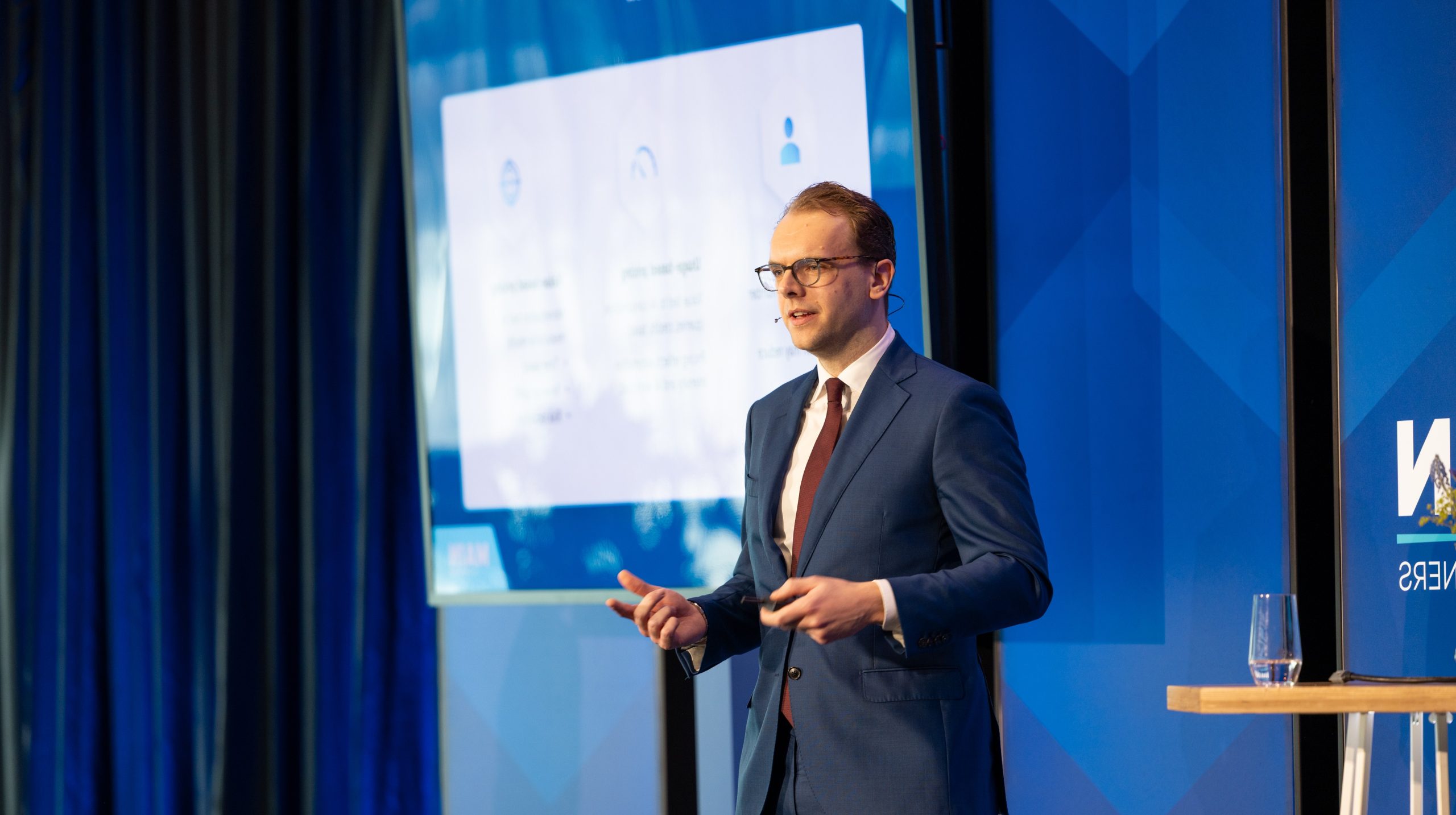
Jason Raats, Product, Tech & AI Lead at Main Capital Partners: “AI Can Make Enterprise Software More Powerful”
How software investor Main Capital Partners views the “SaaSpocalypse” and the future of Enterprise Software.
English translation of an article originally published by M&A, written by Jan Bletz.
Billions in market value recently evaporated at software giants such as SAP and Wolters Kluwer following a sudden wave of AI-related concerns. “That reaction was exaggerated,” says Jason Raats, Lead Product, Tech & AI at investor Main Capital Partners. He explains why Main continues to see ample opportunities for many Enterprise Software companies, precisely because of AI.
Anthropic’s announcement that it was launching an AI tool for legal research was enough to send Wolters Kluwer’s share price down ten percent in a single trading day. RELX lost twelve percent that same day. Earlier this year, SAP, Salesforce and Workday had already seen their share prices fall by more than fifteen percent. The market seemed to draw one conclusion: AI will replace Enterprise Software. Main Capital Partners, an investment firm specializing in Enterprise Software, disagrees.
Main recently published the white paper “Why Enterprise Software Is Well‑Positioned to Capitalize on a New Phase of AI‑Driven Growth” on the impact of AI on the sector. The analysis is based on Main’s proprietary AI Impact Assessment Framework, which evaluates four dimensions:
Each subcategory is scored on a scale from one to five, with minimum acceptance thresholds determining whether AI‑related risks remain within acceptable limits.
The decision to publish a whitepaper was partly pragmatic, says Jason Raats, Product, Tech & AI Lead at Main Capital. “Many investors in our existing funds started asking, in response to the share price declines in Enterprise Software companies, whether the value of these businesses would also deteriorate significantly.”
Main Capital Partners’ answer is largely optimistic. First of all, there is no structural weakening of the sector, but rather a return to historical growth rates after the exceptional post‑Covid years. Growth in the software industry today still stands at around 11–12 percent annually, which is significantly higher than in most other economic sectors.
“When you look at revenues and profitability, we believe the recent share price declines of companies such as Workday and Wolters Kluwer were exaggerated. And the idea that the rise of AI will cause the entire Enterprise Software market to collapse is far too simplistic.”

You can add AI to deliver additional functionality. But fundamentally, the underlying data remains absolutely key.”
That does not mean growth in the Enterprise Software market is entirely unthreatened; the rise of AI can certainly disrupt certain companies. But AI does not affect all software equally, Main’s whitepaper emphasizes. A crucial distinction exists between systems that contain data forming the lifeblood of an organization and less essential tools.
“The former systems provide a ‘mission‑critical system of record’. This is where a company stores all its crucial data; it is the ‘single source of truth’ on which business policy is based. Your accounting system is a clear example. There is no alternative system in which you also keep your financial records, and that system has to be correct. And you’re not going to use three different accounting systems side by side, one is enough.”
That may sound obvious, but the implications are far‑reaching. Accounting software, ERP systems, HR platforms managing payroll — all of these are so deeply embedded in daily operations that switching is not only costly, but also risky. They contain historical data that literally cannot be recreated, and they are surrounded by compliance requirements that demand customization.
For providers of this type of software, the rise of AI is more of an opportunity than a threat. AI does not replace mission‑critical software, but rather adds an intelligent layer on top. AI can offer, for example, the automation of repetitive tasks, better predictions based on historical data, and more user‑friendly interfaces.
As Raats puts it: “You can add AI to deliver additional functionality. But fundamentally, the underlying data remains absolutely key.”
Because these systems contain such vast amounts of critical data for businesses, it is also unlikely that this software will be replaced quickly or that its provider will easily be outcompeted.
The situation is different for non‑mission‑critical software. Think of simple tools that are nice to use but have limited applications, are not deeply integrated with other systems, and can be replaced easily. Generic e‑learning platforms, for example, or tools primarily focused on content generation or pattern recognition: these are the categories Main considers vulnerable.
Where mission‑critical software resembles an impregnable fortress, this type of software has a low moat, a weak protective barrier that competitors can easily cross. Especially with the rise of “vibe coding,” where almost anyone can quickly build an app, such tools are particularly exposed to competition.
Still, the rise of AI also presents challenges for providers of mission‑critical software. In particular, the traditional seat‑based SaaS pricing model may come under pressure. If productivity gains from AI reduce the number of human users required, does that put revenue per license at risk?
Main Capital’s view is that software usage will become decoupled from the number of human users and will be repositioned around output and results. The whitepaper cites research by Simon‑Kucher showing that while only 7 percent of software companies currently use ‘outcome‑based’ pricing, this approach is the most future‑proof.
“There has to be a way to monetize AI features based on the success customers achieve with the software, rather than just charging for access to the platform?” Raats says.
For providers of mission‑critical software, this will be easier than for competitors who still have to prove themselves.
“Every interaction with an AI model costs money. For a software company that integrates ChatGPT or Claude to roll out AI features without knowing whether the value outweighs the costs, it can become very difficult to pass those costs on to customers. And those costs could rise quickly in the future if companies like Anthropic, OpenAI, and other large language model providers increase their prices.”
“That this will happen is very likely: right now, they are still trying to capture market share and are willing to accept large upfront losses. At some point, that will end.”
In short, companies with a ‘high moat’ also enjoy a competitive advantage here, although even they will need to continue adapting their business models, because they are not irreplaceable either.
“Companies that stand still and do nothing with AI will eventually be outcompeted. If they have a strong position, it may take longer. But that moment will come, even for seemingly untouchable companies like SAP. Fortunately, the companies in our portfolio understand that standing still means falling behind, and that the risk of disruption increases if you don’t innovate. By the way, SAP isn’t standing still either.”

From building business connections to dreaming of starting a company, the students joining the MSI Scholarship Program in 2026 have plenty of ambitions. Discover what they hope to learn and meet the mentors who will support them along the way.

When people think of a title sponsorship, they often picture a logo on a jersey, a few advertising boards, and a signature on a contract. But the real value of a partnership often lies elsewhere. According to KZ’s new chairman, Jeroen in ’t Veld, the strength of the collaboration between Hockey Club Klein Switzerland and Main Capital Partners is rooted in shared values: ambition, talent development, social responsibility, and sustainable growth.
In our Working at Main series, we explore the day-to-day experiences and professional growth of our team members. This time, we spoke with Jorn de Ruijter, Partner and Head of Fund Structuring & Investor Relations.

With roots stretching back to the earliest days of commercial computing, Ferranti combines a remarkable heritage with a modern software platform serving today's utility sector. The company traces its name to Sebastian Ziani de Ferranti, the electrical engineering pioneer behind some of the first electricity meters and the Ferranti Mark 1, the world's first commercially available general-purpose computer.

Wouter Vervoorn from the Financial Study Association Rotterdam (FSR) spoke with Tom Derks, Analyst at Main, about his path into PE, life inside the firm, and how Main looks at sector focus and AI.

To help build a more inclusive and future-proof digital economy, Main Capital will support TechMeUp through a sponsorship focused on financing education for future tech professionals.