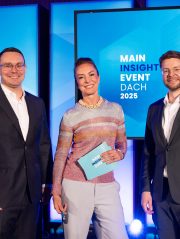
At the heart of this discussion lies data sovereignty.
Long viewed primarily as a compliance requirement, it is now widely recognized as a strategic consideration for innovation, competitiveness, and resilience. This is particularly true for software and industrial companies operating in increasingly regulated and geopolitically complex environments.
Speakers and panel discussions explored how data sovereignty is evolving – and what this means for software enterprises across the DACH region.
From compliance requirement to strategic consideration
Data sovereignty generally refers to the principle that data is governed by the legal and regulatory frameworks of the country or region in which it is generated, stored, or processed. While this has long been relevant for regulatory compliance, the conversations at Main Software 50 DACH 2025 highlighted that its implications now extend far beyond compliance alone.
For many customers – particularly in financial services, healthcare, the public sector, and critical infrastructure – clarity around data location, access control, and governance is often a baseline requirement in vendor selection processes.
As a result, data sovereignty increasingly influences:
- Product and cloud architecture decisions
- Go-to-market strategies in regulated industries
- Trust-based customer relationships
- Readiness for M&A activity and international scalability
A reality check: adoption, hesitation, and expectations
The panel discussion opened with an informal audience poll that illustrated the current state of sovereignty adoption in the region:
- The majority indicated that they evaluate European hosting locations offered by hyperscalers (AWS, Microsoft Azure, Google) or intentionally run critical workloads locally.
- A significant number reported delaying or stopping cloud migration projects or software rollout programs due to data protection, compliance, or cloud location concerns.
- At the same time, a substantial share expressed confidence that the DACH region can build a globally competitive, sovereign cloud stack in the coming years.
In short: sovereignty was broadly viewed as important, while implementation approaches remain uneven across organizations.
“Innovation or sovereignty”? We need both. Now.”
In her keynote, Jessica Bethune (Schneider Electric) emphasized that sovereignty and innovation should not be treated as mutually exclusive from an industrial perspective:
“For the tech industry in Germany and Europe, innovation or sovereignty is no longer a choice. We need both – now. This is no longer a ‘nice to have’, but a question of competitiveness and long-term survival.”
Her remarks directly linked data sovereignty to operational realities in industrial environments, where real-time data underpins safety, efficiency, and resilience. Industrial ecosystems can only function when companies retain control over how data is accessed and shared. As digital connectivity across IoT and OT environments accelerates, control over data becomes increasingly critical.
Digital trust as a competitive differentiator
A recurring theme throughout the Main Software 50 DACH 2025 event was digital trust. Customers increasingly expect that their data is:
- Stored and processed transparently
- Protected against unauthorized access
- Compliant with national and regional regulations
As Bethune noted:
“Data sovereignty is a strategic necessity. It is about being able to decide for ourselves which technologies we use, which data we share, and with whom.”
Software providers that can clearly articulate data residency, encryption control, and applicable legal frameworks are often better positioned to build trust – particularly in regulated industries, but increasingly across the broader enterprise software market.
This perspective was echoed in a recent episode of Deal Decoded, our podcast, featuring Serge Binet, CEO and founder of PRIM’X. PRIM’X provides proprietary solutions for file, disk, email, and Microsoft 365 cloud encryption, including data in transit.
In the episode, Binet emphasized the role of trust in cross-border collaboration:
“Everybody needs the same tools, and everyone accepts that the solution may come from another country in Europe, provided that there is trust. And the main thing is to earn that trust.”
Enabling innovation, not limiting it
Contrary to the perception that sovereignty requirements inherently slow innovation, discussions at the Main Software 50 DACH event suggested the opposite: clear sovereignty frameworks enable faster, more sustainable innovation.
When data governance is well-defined:
- Customers are more willing to share sensitive data
- Cross-organizational collaboration becomes feasible
- AI and data-driven innovation can be developed more responsibly
Architectures that are sovereign by design, including region-specific cloud deployments, strong encryption models, open standards, and modular data layers, allow companies to innovate with confidence while meeting regulatory and customer expectations.
These themes were prominently discussed at this year’s Security Software Dinner in Nuremberg, where the region’s software companies gathered to exchange perspectives and innovative ideas. A shared conclusion emerged: data sovereignty represents a tangible opportunity for the European software sector.
“The solution is software”: sovereignty must perform
In a panel discussion exploring the nuances of digital sovereignty, Max Niroomand (Lyceum Technology) captured a recurring challenge for European providers:
“Everyone thinks sovereignty is great…but I haven’t spoken to a single customer who says they chose us because we’re in Europe. In the end, it’s always about the software.”
The discussion underscored several realities:
- Sovereignty alone is rarely a decisive buying factor.
- Customers ultimately prioritize functionality, reliability, and measurable value.
- European solutions often struggle not due to a lack of vision, but due to product maturity, integration depth, or scale.
The key takeaway: sovereignty becomes compelling only when paired with high-quality, competitive software.
Turning sovereignty into practical solutions
Conversations across events such as the Main Software 50 and the Main Security Software Dinners reveal a clear message: data sovereignty is increasingly viewed as a foundation for digital trust, resilience, and long-term competitiveness.
Within the Main Capital Partners portfolio, several security software companies – including PRIM’X, procilon, Oribi, and Pointsharp – address different aspects of sovereignty-related requirements, such as identity management, secure data exchange, access control, and compliance-ready architectures. Together, they reflect the culture of innovation and forward-thinking that Main actively fosters.
Companies that treat sovereignty not as a constraint, but as a strategic design principle integrated into their products, will be best positioned to lead the next phase of digital transformation – in Europe and beyond.